Steam Machine Hub Explained: Your Central Gaming Command…
Editorial Team ·
Listen to this article~6 min
A Steam Machine Hub isn't hardware you buy—it's a central computer that organizes your entire Steam library, streams games to any device, and simplifies your home gaming setup. Think of it as your gaming command center.
You know that feeling when you're trying to game across different rooms in your house? It can get messy real fast. You might have heard the term 'Steam Machine Hub' floating around and wondered what all the fuss is about. Let's clear something up right away - it's not some fancy new gadget you order online. It's smarter than that. It's a concept, a role that one of your existing computers can play to completely transform how you experience PC gaming at home.
Think of it as the nerve center for everything Steam-related in your house. It's where your gaming universe connects, organizes, and flows out to every screen you own. Whether you're using Steam's Big Picture mode on your living room TV or streaming games to your bedroom laptop, this hub makes it all seamless.
### What Exactly Is a Steam Machine Hub?
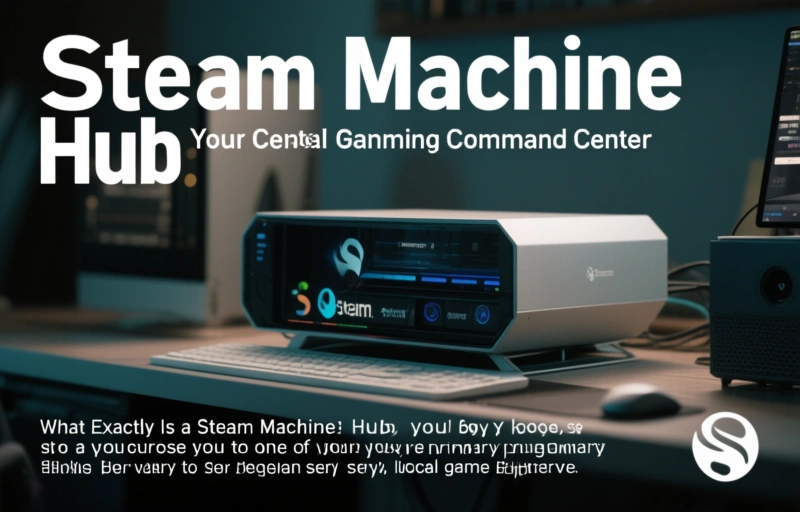
A Steam Machine Hub isn't a product you buy. It's a purpose you give to one of your computers. This becomes your primary gaming library, your local game server, and your media center - all wrapped into one reliable machine. It's the PC you leave running in your living room, connected to your big screen, ready to launch into gaming with just a controller press.
Or maybe it's that powerful desktop in your home office that streams games to your devices elsewhere. That's where the 'hub' concept really shines. This central machine acts as the source for everything. From it, you can stream games to other, less powerful devices using Steam's in-home streaming technology.
You're basically centralizing your storage, your save files, and your processing power. It simplifies everything beautifully. No more installing that same massive 100GB game on three different computers. Install it once on your hub, and access it from anywhere on your home network. It's a genuine game-saver, both literally and figuratively.
Now, you might be wondering about network performance - and you absolutely should. A wired Ethernet connection is your best friend here. Wi-Fi can work in a pinch, but for smooth, lag-free gaming, especially with fast-paced titles, you want that physical cable connection. It makes all the difference between a seamless experience and a frustrating, stuttering mess.
### Building or Choosing Your Perfect Hub Machine
Let's get practical. What makes a computer a good candidate for this hub role? You don't need the absolute latest, most expensive graphics card. What you really need is reliability and strong encoding capabilities for streaming. A modern mid-range CPU with integrated graphics can often handle streaming encoding surprisingly well.
If your hub is also your primary gaming rig, then sure, include a decent dedicated graphics card. The real key is consistency. This machine is going to be running a lot - think about good cooling and a quality power supply. They might not be glamorous components, but they're absolutely essential for a set-it-and-forget-it hub that just works.
Storage is another huge consideration. This is where your entire gaming library lives. Consider this classic combination:
- A fast NVMe SSD (like 1TB or 2TB) for your current favorite games
- A massive, reliable hard drive (think 4TB to 8TB) for the rest of your backlog
Organization becomes part of the hub's job too. Using Steam's library folders and categories effectively turns your hub into a beautifully curated gaming portal. Here's a quick historical note: The original 'Steam Machine' initiative from Valve was about pre-built living room PCs. That project eventually faded, but the community kept the dream alive. Today, your Steam Machine Hub is a DIY version of that vision - tailored exactly to your needs without any locked-down hardware limitations.
### Why Bother Setting Up a Hub? The Real Benefits
Honestly? The biggest benefit is pure convenience. It's about removing friction from your gaming time. You walk into any room, pick up a controller or sit at a keyboard, and your entire library is just... there. No updates to sync across devices, no save files to manually transfer. Everything lives on and is managed by the hub.
It's also incredibly cost-effective. You can invest in one really solid gaming PC (your hub) and then use cheaper, lower-powered devices as your endpoints. An old laptop, a mini-PC, even a tablet with the Steam Link app - they all become capable gaming clients. This approach saves you from needing a high-end gaming rig in every single room of your house.
Then there's the multiplayer angle that often gets overlooked. Your hub can host local game servers for you and your friends. Playing something like Valheim or Terraria? Host the server on your always-on hub. Your friends can connect anytime, and the server stays running smoothly without tying up your main gaming computer.
It's about creating a gaming ecosystem that works for you, not against you. The initial setup might take some thought, but once it's running, you'll wonder how you ever gamed without this centralized approach. Your games, your saves, your experience - all unified and accessible from anywhere in your home. That's the real power of a Steam Machine Hub.